On this page
A November research update
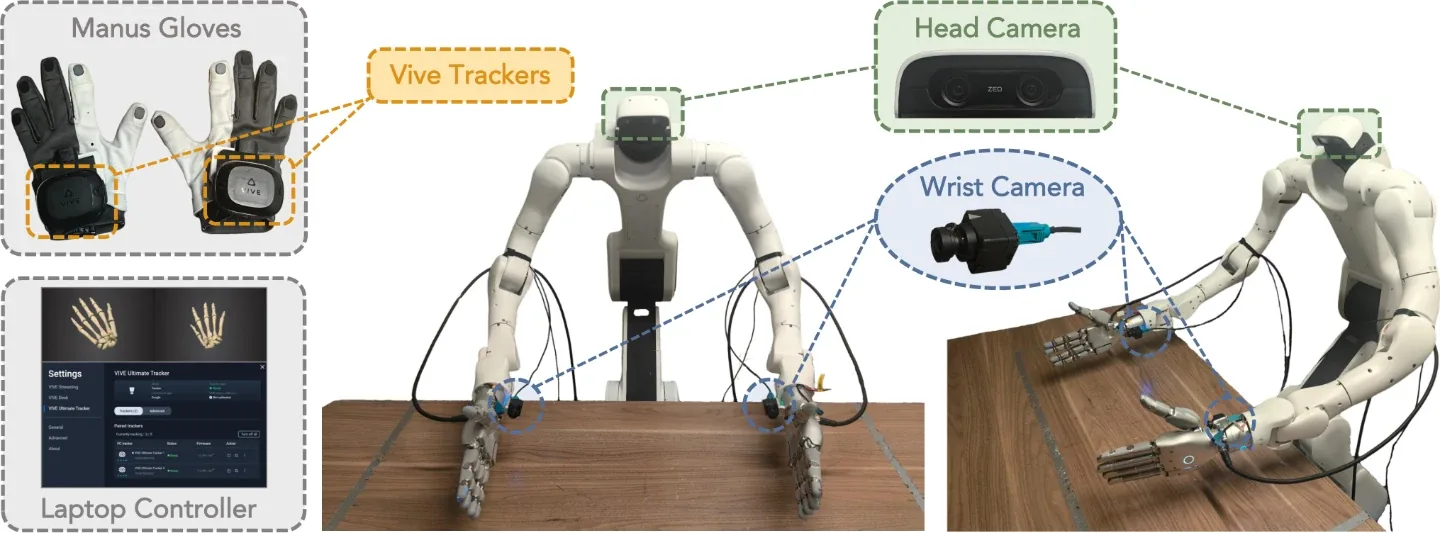
On 5 November, Panasonic Holdings described T-Rex, developed with researchers from UC Berkeley, NVIDIA and other institutions. The work brings fingertip touch into a vision-language-action (VLA) model to adjust actions as contact changes.
Planning and correction
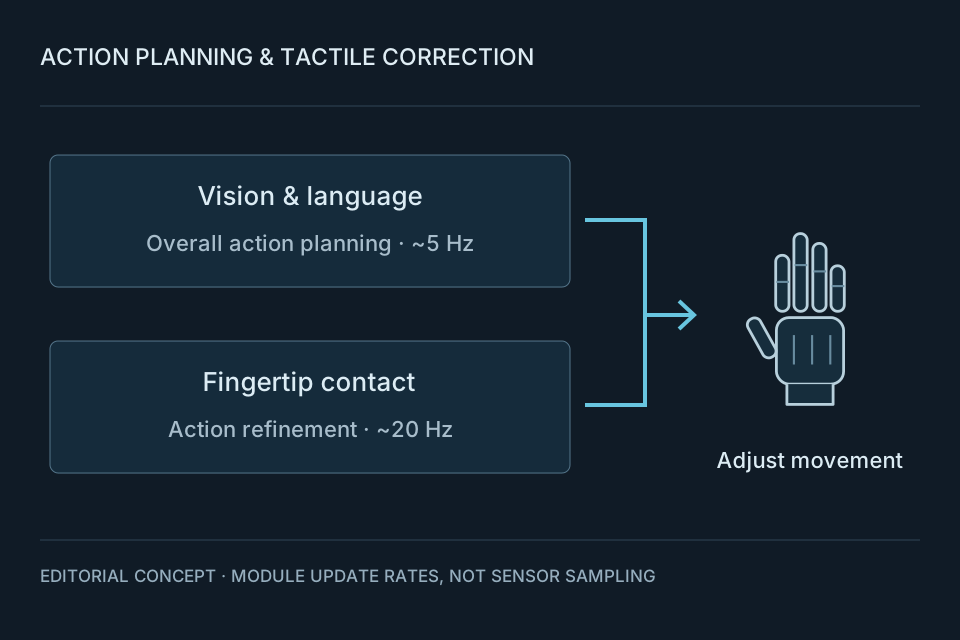
The approach combines overall movement planning with touch-driven refinements.
- Vision and language guide the overall action, updating at approximately 5 Hz.
- A tactile correction module refines actions at approximately 20 Hz.
Read the results with the conditions
The project reports an average success rate of 65% across 12 contact-rich tasks, compared with 35% for its strongest baseline.
Failure cases are part of the story
The project also describes collisions, slipping, inaccurate placement and excessive force. Touch-sensitive manipulation still needs evaluation on the intended hardware, task and training setup.
Three questions for a useful trial
Our interpretation: assess how tactile information enters the operating workflow, as well as whether it is available.
- What is recorded? Identify each signal’s location and physical meaning.
- When does it happen? Check alignment between touch, video and action records.
- How will it be tested? Use a short, repeatable task to connect contact changes with the outcome.